
Read the digital document above, download a copy here or keep reading below.
President Donald Trump has made it clear, in both his business life and his political life, that he believes that ‘unpredictability’ is one of his strongest assets, writes Major General (Retd) Dr Andrew Sharpe. Whether one agrees, or not, that this is a helpful approach to the delicate business of international relations, it is the reality behind the pivotal effects that the US leadership currently has on world events. Keeping his opponents (and friends) off-balance, confused and unclear about his end-game, and therefore likely intended actions, has long been central to how he plays his cards.
By contrast, philosophers and theorists of the use of war as a tool by political leaders have, for centuries, been equally clear that clarity of the intended ‘end game’ has both moral and practical imperatives. Whether one considers the problem through the lens of Just War Theory, or Clausewitzean philosophy, it is vital to understand the ‘ends’ behind the ‘ways and means’. Just War Theory tells us that war, as an instrument of national policy, is only justifiable if, among other things, the person choosing to use war to realise their aims has ‘a reasonable chance of achieving success’. Of course, it is impossible to judge what might constitute ‘a chance of success’ if one has no clarity about what ‘success’ looks like. In both moral and practical terms, Clausewitz reminded us that because war is an extension of policy by other means, it is both morally and practically vital that the aims and desired outcomes are clearly understood and articulated before the decision to use violence is taken. There is no point in using war, he explained, if one does not clearly understand, in advance, what one wants to happen after war has been used and a return to more normal relations achieved.
In the lead-up to the Iraq campaign in 2003, Donald Rumsfeld, then the US Secretary of Defense, agreed with the ‘Neocon’ view that air-delivered regime change (or, if air-delivery alone fails, then a rapid and conclusive ground campaign, just to make sure) would inevitably lead to the uprising of the oppressed and disgruntled people of the state in question, who, through the unstoppable power and efficacy of democracy, would deliver a new, stable, happy and prosperous state that would be benign and beneficial both to its inhabitants and neighbours, and thus, thereafter, globally. Colin Powell, then the US Secretary of State in the same administration, held what he called ‘the pottery barn’ view of regime change, which is to say he quoted the notices in such establishments that say “If you break it, you own it!”. So, he believed that those bringing about regime change needed to understand (and thus plan for) their responsibility post-change to be involved, to conclusion, in the internal state-of-affairs in the changed country until the desired conclusion was reached. The resulting muddled compromise between the two produced the much-analysed and criticised situation whose echoes still trouble Iraq. In short, chaos ensued. And yet, both divided views of the ‘ways and means’ were, at least, agreed on the ‘ends’.
It may be that Donald Trump, and his supporting Secretary for War Pete Hegseth, hold with the Donald Rumsfeld view. Certainly, once one strips away the bluster and rhetoric, Trump appears to be appealing to the people of Iran to get on and finish the job of regime change now that he has given them a “once in a lifetime opportunity” so to do. All of his pre-election pronouncements suggest that Trump is firmly against any US boots-on-the-ground interventions abroad (and, vitally, his MAGA-base supporters are counting on that). The so-called ‘Donroe Doctrine’ is absolutely about US isolationism and non-involvement with others’ problems. Yet events in Venezuela suggested otherwise. And events in Iran fly in the face of that stance. Is this turn of events an indication of a carefully executed game-plan, designed to keep opponents (and allies) off-balance, in a classic Trumpian business model? Or is it just the product of instinct and impulse, with little measured analysis of consequence management issues? We don’t know. The anti-Trump camp make all kinds of accusations, ranging from irresponsibility at best, to lunacy and a rattled attempt to distract from the Epstein files at worst. The pro-Trump camp offer a bold view of strength solving a global-pariah threat that others have shied away from.
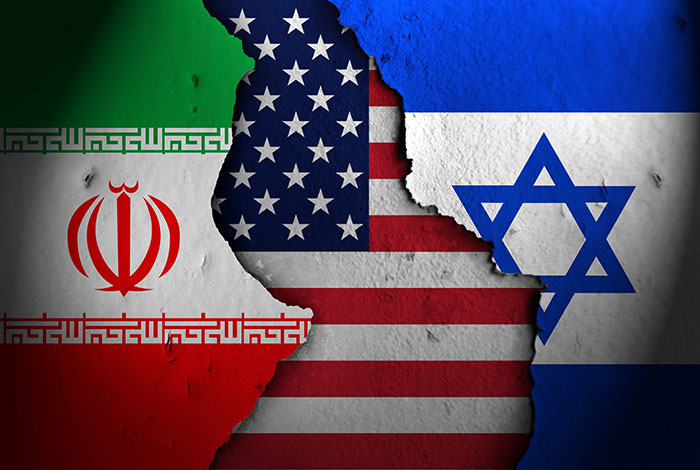
Although this analysis is both interesting and useful, it does not, however, solve the practical problems that are facing not just Iranians, nor regional citizens and governments, but all of us. The ripples of the US/Israeli attacks on Iran are spreading rapidly, long past the range of a Shahed drone or ballistic missile. All of us are going to need to think long and hard about the implications, and possible outcomes, with which we will need to deal – whether economically, politically or militarily – over the coming weeks and months. In the long run, the real wisdom, perhaps, is to be found in exploring the view espoused by the late Professor Colin Gray. Among his many wise words on the subject of international affairs, Gray suggested that the whole business of strategy is not so much about the plans that you make, nor even about the actions that you take, but rather it is about the management of the consequences of those plans and actions. As we analyse what is happening, alongside, perhaps, what Donald Trump intends, we must also ask ourselves some urgent, practical, questions. Questions like: how and with what are we all going to be involved in managing the consequences of Donald Trump’s decisions and actions… ?