
Read the digital document above or download a copy here or keep reading below.
SHIFTING SANDS: THE SAHEL’S SURGING SECURITY CRISIS
By Sam Deans, Visiting Fellow, CHACR
A power vacuum is opening in the Sahel. Non-state actors, particularly the Jama’at Nusrat al-Islam wal-Muslimin (JNIM), an affiliate of Al-Qaeda, and the Islamic State-Sahel Province (IS-Sahel), seem intent on filling that vacuum in the short term. The scales are tipping in their favour. In a region gripped by resource scarcity, exacerbated by climate change and fragile governance, Sahelians are increasingly siding with those who offer order rather than those who claim legitimacy.
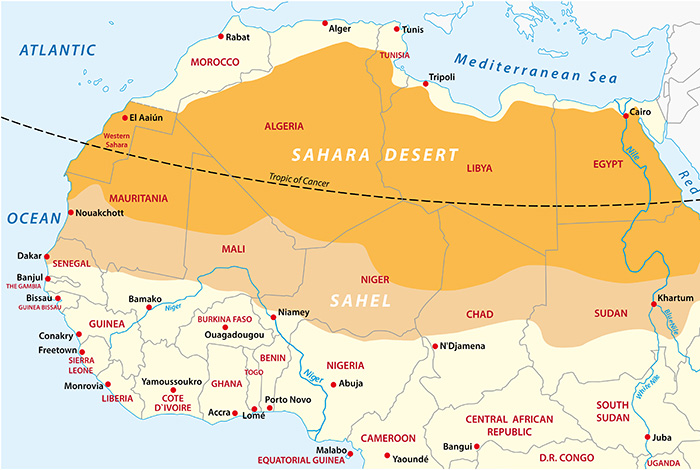
Mali and Burkina Faso now rank, respectively, as the first and third countries most affected by terrorism globally, and Niger has the fastest-growing population in Africa, which is set to double by 2050. The wider Sahel is home to a population of 400 million, and projected to reach over 500 million by 2050. It is also the youngest regional population in the world, with 65 per cent being under the age of 25. This booming population will only intensify existing competition for limited resources amongst communities overwhelmingly reliant on agriculture, affected by rising temperatures, irregular rainfall and shifting seasonal patterns, creating fertile conditions for the expansion of Al-Qaeda, the Islamic State and other violent non-state actors (VNSA) in the region preying on the insecurity to attract vulnerable people. The region is moving towards a humanitarian catastrophe, one that will inevitably reverberate outwards, posing long-term security threats to Europe and beyond.
What distinguishes the current VNSA threat in the Sahel from previous iterations is its deliberate and increasingly sophisticated exploitation of state absence. JNIM and IS-Sahel are now responsible for more than 60 per cent of incidents of insecurity in the central Sahel, launching between 35 and 40 attacks per week. VNSAs have moved well beyond insurgency tactics, establishing parallel governance structures in areas abandoned by the central government. JNIM and IS-Sahel are deliberately destroying water infrastructure and state services to induce dependency, whilst simultaneously positioning themselves as the alternative, arbitrating land disputes, distributing food and providing basic security. In Tillabéry, Niger, some communities view IS-Sahel as more competent at resolving land disputes than the government; in parts of Burkina Faso, citizens actively prioritise ‘jihadist’ counsel over state services. As one Sahelian put it: “A hungry man is not free; if someone offers food for your starving children, you will follow them.” This is not simple opportunism, but a calculated strategy to embed legitimacy that conventional military forces struggle to dislodge. The more territory JNIM governs, the harder it becomes to distinguish between liberating a population and displacing the only ‘legitimate’ authority they know. Russia and the Africa Corps have no answer to this dynamic, nor yet does anyone else, and VNSAs are exploiting this gap.
The scale of JNIM’s ambition was made unmistakably clear in April 2026. On the 25th and 26th, militants from JNIM and secessionist fighters from the Azawad Liberation Front (FLA) launched several attacks across the Malian cities of Sevare, Gao, Kidal, Kati and the capital Bamako. The “scale and coordination” of the attacks was “unprecedented”. The two groups, historically at odds, recently formed an alliance to topple the Malian government. Malian Defence Minister, General Sadio Camara, was killed following a suicide bombing at his residence the same day. The targeting of Camara, a key ally of Moscow, is part of a series of setbacks Russia has suffered in the country, as the Africa Corps surrendered its key base in northern Mali. The Africa Corps launched a series of counterattacks against the alliance, and the government has so far resisted capitulation. The security situation in Mali is troubling, as the country drifts towards fragmentation amid warring factions.
This setback is part of a wider pattern of failed Russian intervention in the country. The origins of this intervention lie in the Alliance of Sahel States (AES), launched in 2023 and comprising Mali, Niger, and Burkina Faso, which make up the ‘Coup Belt’. These countries expelled French and US military forces, vital to counter-terror operations in the region, expanded diplomatic ties with Russia and left the Economic Community of West African States (ECOWAS). These countries are all led by military juntas, regularly espouse anti-Western ideas and suffer widespread corruption. It was into this newly created opening that Russian private military companies (PMC) moved, offering an alternative security model that suited the juntas’ political interests as much as their military needs.
The recalibration of AES security towards Russia saw the introduction of PMCs into the region, spearheaded by the Wagner Group. Crucially, Wagner operated as an ‘independent’ organisation, negotiating its own compensation with host states, a model advantageous to Moscow, which could pursue overseas objectives without directly funding them, nor getting its hands dirty.
In the Sahel specifically, Wagner’s model appeared to be working. There were PMC boots on the ground, resources were flowing back to Moscow, and plausible deniability was intact. Two interconnected developments have since undermined that model: the Wagner mutiny in 2023 and the wider Ukraine War. Following operational failures in Ukraine, Wagner, under the direction of leader Yevgeny Prigozhin, marched toward Moscow in an ill-fated mutiny. Prigozhin and other key leaders in Wagner died weeks later in a mysterious plane crash. The Kremlin moved swiftly to absorb Wagner’s network, but in doing so lost the one thing that had made it so effective: its independence from the state and subsequent flexibility. The newly formed Africa Corps, now under state control, cannot negotiate, deploy or withdraw with the agility Wagner once had. It is slowed by bureaucracy at every step.
Ukraine has compounded the problem further. Manpower, equipment and funding that might otherwise have sustained operations globally, including in the Sahel, are now being consumed by the front lines. Arms exports have declined sharply, and the quality of personnel being deployed overseas is likely to have fallen accordingly. Russia is not withdrawing from the Sahel, but it is losing ground, and the vacuum left behind is widening each month.
As Russia fails to contain the growing VNSA threat, China is moving to fill the space. As part of its wider Belt and Road Initiative, Beijing unveiled an ambitious plan for Africa in 2024, committing $51 billion in new funding over three years, a significant portion of which has been directed into the resource-rich Sahel. In Niger, China has invested just short of $7 billion in the country’s oilfields and pipelines; Chinese companies control two of Mali’s largest lithium mines; China has also heavily invested in Burkina Faso through the development of industries in energy and cement, to name but a few.
These investments have seen an increased Chinese footprint on the ground. The increased investment and accompanying workers have become targets for VNSAs in the Sahel. In 2025, 40 per cent of foreign nationals who were kidnapped in Africa were Chinese. The Kayes region in western Mali saw four separate attacks on Chinese workers and businesses in just four weeks, resulting in kidnappings, theft of equipment and destruction of property. Chinese staff working in Niger’s Agadem oil field were taken hostage. The kidnapping of foreign nationals in the Sahel surged in 2025, with JNIM being the “overwhelming culprit”. The influx of Chinese business into the region has not stabilised it; instead, it has created a new point of friction. Its nationals and assets are becoming prizes for VNSAs in a conflict that Beijing has no current capacity or appetite to resolve.
The confluence of these pressures creates conditions for instability on a scale the Sahel has not yet seen. VNSA operational capacity is expanding; Sahel governments are weakening; Russian PMCs are increasingly overstretched; climate change is deepening resource competitions across a population that is both vast and overwhelmingly young. Into this environment, China is pouring capital; however, capital without security is merely another vulnerability for VNSAs to exploit. The Sahel is not simply drifting towards crisis. It is being pulled there by forces that simultaneously accelerate and compound one another.
Of those competing to fill the vacuum, VNSAs hold the clearest advantage. The conditions are working in their favour, and unlike any state actor currently present in the region, they require no diplomatic mandate, no political justification and no public accountability. They are already embedded in the communities and governance gaps that have created the Sahel crisis. China’s capital investment is significant for regional dynamics, yet Beijing has shown little appetite for the kind of direct counterinsurgency commitment that stabilisation would actually require. A consolidated VNSA-controlled Sahel would not remain an isolated problem for long.
For Europe, the consequences are direct. The Sahel has already emerged as a significant driver of irregular migration into the continent, with displacement corridors running from Burkina Faso through Niger’s Agadez into Libya and across the Mediterranean; a governance collapse across the AES states would dramatically accelerate that movement. On terrorism, JNIM and IS-Sahel are already expanding southwards towards the coastal states of Benin and Togo. A consolidation of VNSA control across the central Sahel would provide the kind of territorial depth and operational freedom that would fundamentally transform their capacity to project beyond the region. On resources, the Sahel sits atop significant deposits of uranium, lithium and gold, materials central to Western defence supply chains and the green energy transition; Chinese or VNSA control over those deposits would hand an adversary considerable strategic leverage.
For Europe, and therefore Britain, all of this presents a problem that is not going to go away, but, on the contrary, is only likely to become more intense, more intractable and ever less accessible. European engagement with the region, especially after the ejection of France, is now extremely difficult. Inattention, on the other hand, is likely to have consequences. The Sahel may be a distant crisis now, but it is also a slow catastrophe unfolding in plain sight; and there will be global consequences.